

Renewable Energy
Communities
“There is true progress only when
the benefits of a new
technology
become available to everyone.”
-Henry Ford
Who can take part in a Renewable Energy Community

Residents and condominiums

Associations

Cooperatives

Local and religious bodies

Small and medium-sized enterprises

Third sector
Who can take part in a Renewable Energy Community
Residents and condominiums
Associations
Cooperatives
Local and religious bodies
Small and medium-sized enterprises
Third sector
How a REC works
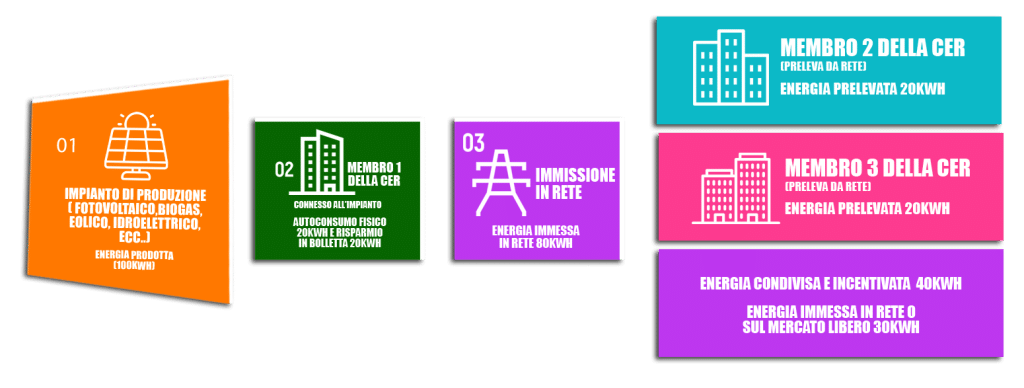
The energy produced can be consumed directly by members physically connected to the plant, delivering immediate savings on their bills through self-consumption.
Unused energy is fed into the grid and shared among members through a virtual exchange. This way, every participant can draw the energy they need from the grid, even if they are not directly connected to the plant.
If production exceeds consumption, the surplus energy can be sold on the free market or fed into the national grid, generating further economic benefits for the community.
How a REC works
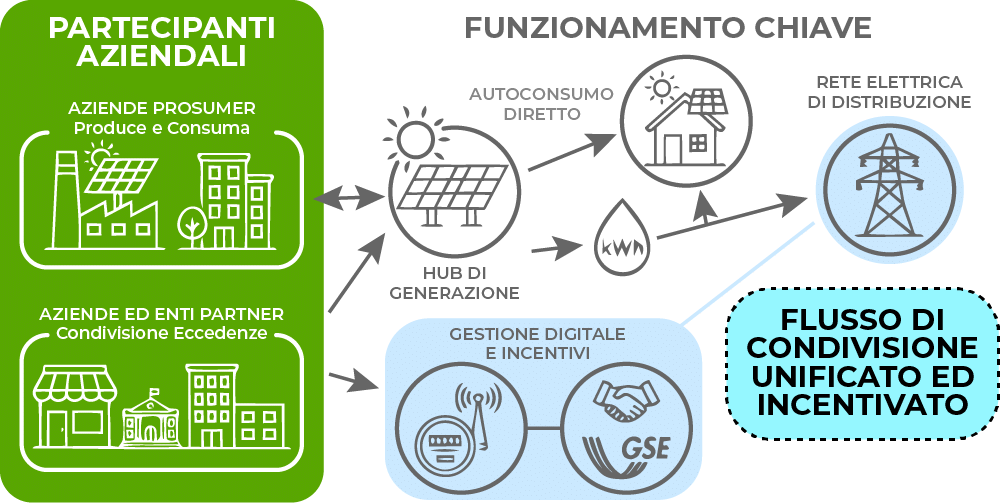
The energy produced can be consumed directly by members physically connected to the plant, delivering immediate savings on their bills through self-consumption.
Unused energy is fed into the grid and shared among members through a virtual exchange. This way, every participant can draw the energy they need from the grid, even if they are not directly connected to the plant.
If production exceeds consumption, the surplus energy can be sold on the free market or fed into the national grid, generating further economic benefits for the community.
How collective self-consumption works
Collective self-consumption groups are made up of users, often within the same building or complex such as a condominium, who produce and use renewable energy locally, for example through a shared solar PV plant, to cover their own energy needs.
The energy produced can be stored or sold, provided that this is not the participants’ main business activity.
Different ways to contribute to and join a renewable energy community
Available space
You can take part by offering spaces such as company rooftops, warehouses or land suitable for installing energy plants.
Energy demand
You can join by sharing your consumption, which is essential to power the collective energy network.
Existing plants
If you own a solar PV plant or a grid-connected self-consumption system, you can add it to the community and contribute to renewable energy production.
Noon
for the production and
sharing
of renewable
energy
As an Energy Service Company, we provide
full support in managing RECs, so that community members can focus on what really matters:
sharing energy and the economic benefits of taking part.
Drawing on our experience, we can guide you through every stage of the process, taking care of:
- governance set-up and permit applications
for installing the plants - design and installation of the solar PV plants
- technical management for the operation / maintenance
of the plants - consumption optimisation with innovative
monitoring systems - financial aspects of sharing revenues among
REC members
Why join a REC
Environmental benefits
They contribute to the goals of Italy's National Integrated Energy and Climate Plan through:
• Lower CO2 emissions (a 40% cut in greenhouse gas emissions by 2030 compared with 1990 levels);
• Greater use of renewables (renewables must reach 30% of gross final energy consumption by 2030)
• A significant contribution to the country's ecological and energy transition.
• Lower CO2 emissions (a 40% cut in greenhouse gas emissions by 2030 compared with 1990 levels);
• Greater use of renewables (renewables must reach 30% of gross final energy consumption by 2030)
• A significant contribution to the country's ecological and energy transition.
Economic benefits
Lower energy costs for citizens and businesses through:
• An incentive of €110/MWh for energy produced and self-consumed by the REC, granted for 20 years.
• A refund of €4.5/MWh for reduced transmission and distribution losses.
• Payment for energy fed into the grid at the hourly zonal price.
• High value-added services at lower cost for all REC members thanks to aggregation.
Social benefits
RECs are true social innovations, designed to:
• Bring new players into the energy production model, making energy a common good accessible to all, especially those who are economically disadvantaged.
• Reinvest incentive revenues in high-value social services for members.
• Reduce the country's dependence on energy imports.
• Bring new players into the energy production model, making energy a common good accessible to all, especially those who are economically disadvantaged.
• Reinvest incentive revenues in high-value social services for members.
• Reduce the country's dependence on energy imports.
Technical benefits
Self-consumption within the REC significantly increases the efficiency of the electricity grid for the benefit of the community, because it helps to:
• Reduce transmission / distribution losses
• Mitigate imbalances between supply and demand
• Reduce transmission / distribution losses
• Mitigate imbalances between supply and demand